6 Things People Get Wrong About LED Bulbs

Got LEDs? Now that last summer’s new efficiency mandates all but phase out incandescent and halogen light bulbs, LEDs have become the new lighting standard in American homes. But the requirements aren’t a complete incandescent light ban, and there are many households still using incandescent bulbs whether out of habit, uncertainty, or an understandable resistance to newer technologies (if it ain’t broke, don’t fix it, right?).
If you’re an LED skeptic, read on to learn how it stacks up to incandescents, an essential introduction to LED lighting and its benefits, and design tips for using it in your home.
LED and Incandescent Pros and Cons
Looking for a quick reference guide? Here’s an overview of the pros and cons of LED and incandescent bulbs.
|
|
LEDs |
Incandescents |
| Pros |
-Consume less energy |
-Emit all colors of light -Dimmable -May be a heat source -Lower cost |
| Cons | -Provide more directional light -Higher upfront cost -Not all are dimmable |
-Not energy efficient -Can overheat -Shorter lifespan |
LED vs. Incandescent, What’s the Difference?
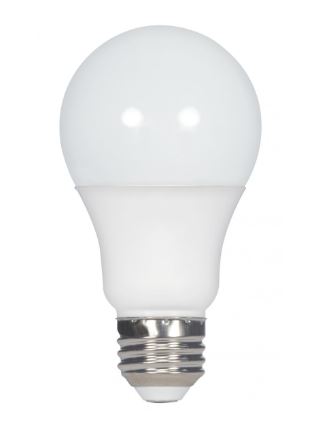
SATCO | NUVO 10 Watt LED bulb
While LED and incandescent light bulbs both offer a broad spectrum of light at various color temperatures, they produce light in different ways.
What Are LED Bulbs?
LED stands for light-emitting diode. LED bulbs work by passing an electrical current through a semiconductor that converts the energy into visible light. LEDs are incredibly energy efficient, and because they use a semiconductor instead of a filament to produce light, they offer a lifespan that’s 30 to 50 times longer than incandescent lights, according to the U.S. Department of Energy.
What Are Incandescent Bulbs?
Incandescent lighting has been around since 1879 when Alexander Graham Bell invented the filament bulb and subsequently brought electricity to American households. Incandescent light bulbs work by sending electric current to a filament that heats up and produces light. Because incandescents require the extra step of converting current to heat, they require more energy to produce light and are less energy efficient than LEDs. The filament piece in the bulb also burns out relatively quickly reducing its lifespan and requires frequent replacement.
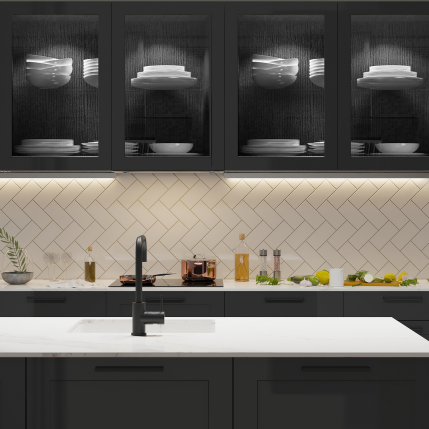
WAC task light
6 Misconceptions About LEDs
With their increased energy efficiency, coupled with the government’s new requirements, LED use is becoming standard. Even so, there are still some myths and misunderstandings about LED features and characteristics. Here are a few of the most common misconceptions:
1. LEDs only emit blue light
Forget what you know about watts. LEDs are measured in the amount of brightness or lumens and by color temperature (Kelvin). LED bulbs offer a wide range of color temperatures from warm white at 2700K up to daylight white at 6500K with an impressive range in between. Warm white is more popular in homes because it offers a soft glow ideal for ambient lighting. Bulbs in the 3000 to 4500K range are more suitable for high-task spaces like kitchens, home offices, and laundry rooms.

Craftmade | 4 Watt LED Bulb
2. LED bulbs last forever
While LEDs offer significantly more hours of light than their incandescent counterparts, they do require replacing. On average, an LED bulb provides between 30,000 to 50,000 hours of light, according to the Department of Energy. If you leave your light fixture on for 10 hours a day, your LED bulb will last between eight and 14 years. What’s more, thanks to their semiconductors, LED bulbs don’t completely burn out or stop working — they simply dim and lose their output compared to their peak performance.
3. When the LED bulb goes out you have to replace the fixture
This is a common myth about switching to LED bulbs and is one of the primary reasons people are often reluctant to make the change. Replacing light fixtures can be expensive! More often than not, you will not need to purchase all new fixtures. An exception to this if the diodes are part of the fixture itself and are not replaceable.
4. LEDs are too expensive
While the average cost of LED is higher, they pay for themselves over their longer lifespans and energy savings. U.S. households save $225 per year on average after switching to LED lightbulbs.
5. LEDs are harmful to the eyes
This myth is an offshoot of the misconception that LEDs only produce blue light whose long-term exposure is linked to retinal damage and other vision problems. In truth, LED bulbs come in a variety of color temperatures offering different levels of brightness and warmth. For example, an LED bulb rated at 4000 Kelvin is a natural light, while a 3000K bulb provides a warm white.
6. LEDs are confusing to work with
While LED technology was invented nearly 100 years ago, it only started becoming mainstream around 2010. Compared to incandescents, LED technology adoption is still considered relatively new. A sense of confusion is natural when adopting a newer technology. Warm white and bright white are the two more popular LED bulb choices among homeowners and serve as good starting points in your research.
Debbie Loyd from The Light House Gallery recommends her customers start small with LEDs in a high-task area like a home office or hobby room to get a feel for them. “We tell them [our customers], ‘Take these bulbs put them in your lamp, see what it does for your desk . . . And if you don’t like that light output, bring it back, we’ll make a change.’ It almost never happens because we’ve spent enough time finding out what their needs are that the next thing you know, they are coming back and changing more rooms out.
Lighting showrooms are helpful resources as you begin updating your home with LED lighting. Their expert knowledge of LED features can guide you to make the best choice for each room in your home.
LED Benefits
When it comes to the home, LEDs are team players in your interior design and can help you create your desired atmosphere. Here are a few tips from the pros on how to integrate LED lighting in your home.
Select from a broad spectrum of color temperatures
LEDs are rated in Kelvin and offer a range of color temperatures from warm amber to bright daylight. A bulb’s color temperature can dramatically affect the mood and feel of a room. It also helps accentuate different colors and textures in furniture, textiles, and artwork.
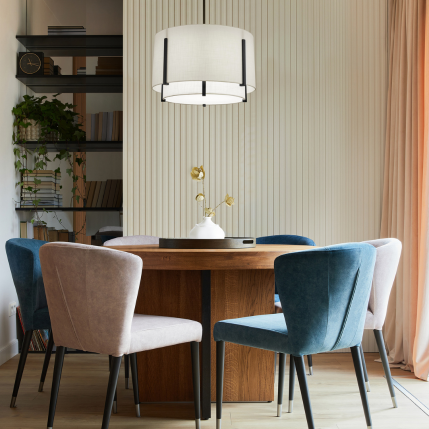
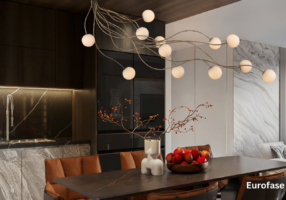
WAC Strum Pendant
The lower the number the warmer the light’s color. “The best way to create the perfect ambiance would be through the right color temperature, brightness level and strategic placement,” says Isfira Jensen, CEO and principal designer of Nufacet Interiors.
If you’re unsure about which color temperature is best for your rooms, a lighting showroom can show you examples of each bulb to help you make the right choice.
Dim Them
Some LED bulbs are dimmable to help you adjust the brightness in a room depending on how you use the space and the time of day. “Not all LEDs work with existing dimmer switches, leading to flickering or uneven dimming,” says Jensen. Read bulb packaging to be sure you’re buying a dimmable product, or reach out to your local lighting showroom for help.
Flex your design muscles
There’s more to LED’s energy efficiencies than lower energy bills. The type of light they produce can enhance your home’s interior design. “LEDs redefine lighting design,” says Artem Kropovinsky, interior designer and founder of Arsight. He specifically notes their energy efficiency can change the look of a space through fixtures. “This allows for a more elaborate design that doesn’t have heat issues. They are also smaller in size to suit modern minimalist spaces.”
The Year of the LED
With all of LED lighting’s benefits, now is a great time to make the switch. A member lighting showroom can help. Contact or visit one in your area for expert guidance on all things LED, including which bulbs are right for each room, color temperatures, and dimmable features.

Bathroom Lighting Trends

Kitchen Lighting Trends

Outdoor Lighting Trends

Design